On July 4, 2026, the United States turns 250. The formal name for a 250th anniversary is the Semiquincentennial; the shorthand everyone is using is America250. Either way, it marks a quarter-millennium since the Continental Congress adopted the Declaration of Independence in Philadelphia.
I wanted to mark the occasion with something more durable than fireworks. This is a watch list. It is not a “greatest hits of patriotism” reel. It is a guided tour through one specific question. Why did thirteen British colonies decide they needed to become their own country? It was not inevitable. For most of the 1760s and early 1770s, the colonists wanted their rights restored within the empire, not a new nation. Something changed. This list is about what.
I’ve organized it around the actual causes of independence, in three movements. The first is the imperial squeeze that lit the fuse. The second is the ideas that gave the anger a moral shape. The third is the flashpoints that turned protest into a Declaration. Underneath all three runs a fourth, quieter theme. A slaveholding people declared that all men are created equal, and I’ve tried to pick titles that face that contradiction honestly rather than look away.
A note on sources. I’ve mixed free and paid throughout, and flagged which is which. Streaming licensing rotates constantly, so treat availability as true only as of mid-2026, and check JustWatch for your region. I’ve also been candid about historical accuracy. Some beloved titles are rousing entertainment and lousy history, and you deserve to know which.
First, the anchors
If you watch nothing else, watch these four. Between them they cover every major cause, and they all hold up.
- Ken Burns: The American Revolution (PBS, 2025). IMDb. The new gold-standard survey. Six parts and roughly 12 hours trace the whole arc from postwar debt and the tax crises through Yorktown, with unusual attention to Native nations, Loyalists, and enslaved people. Episode 1, “In Order to Be Free,” covers the causes in one sitting. It holds a 96% rating on Rotten Tomatoes. Watch: PBS official. It is on PBS Passport or Prime Video and is paid as of 2026, though PBS scheduled broadcast re-airs around July 4. See where to watch.
- Liberty! The American Revolution (PBS, 1997). IMDb. This is the pre-Burns classic, and it remains the cleanest cause-by-cause walkthrough of 1763 through 1789. It won a Peabody. Watch: it is free on Kanopy with a library card, and full episodes are on the official YouTube playlist.
- John Adams (HBO, 2008). IMDb. This is the finest dramatization on the list, and it won a record-setting 13 Emmys. It opens with Adams defending the British soldiers after the Boston Massacre and carries through the agonized politics of declaring independence. Watch: Max.
- 1776 (1972). IMDb. This musical follows the Continental Congress arguing itself toward independence. Remarkably, it is also the most honest mainstream film about the slavery compromise that nearly killed the Declaration, captured in the number “Molasses to Rum.” Much of the dialogue is drawn from real letters. Watch: it is free on Tubi. See where to watch.
Movement I: The imperial squeeze
For 150 years Britain governed the colonies loosely, under a policy later nicknamed salutary neglect. Then the Seven Years’ War, known here as the French and Indian War, ended in 1763 and left Britain buried in debt. London decided the colonies should help pay, and it started enforcing rules it had long let slide. To colonists who had come to treat self-rule and cheap trade as their birthright, the reversal felt like a betrayal. The Proclamation of 1763 fenced them out of the West. The Stamp Act (1765) taxed nearly every piece of paper. The Townshend Acts and the Navigation Acts funneled all trade through Britain, and a standing army was quartered among them in peacetime. “No taxation without representation” was the rallying cry, but the deeper grievance was the sudden reach of a distant government into colonial life.
Watch:
- Benjamin Franklin (Ken Burns, PBS, 2022). IMDb. Four hours follow the man who began as a loyal subject lobbying in London and slowly radicalized into a revolutionary. It is the best portrait of how a colonist’s mind changed in these years. Watch: it is free on PBS. See where to watch.
- The Revolution (HISTORY, 2006). IMDb. This 13-episode reenactment-driven survey is workmanlike but thorough on the chain of acts and taxes. Watch: it is free with ads on Plex, and it is also on History Vault by subscription.
- Townsends (YouTube). This channel is not about politics at all, but it is the best window into what 18th-century colonial life actually felt like. It covers the food, the clothes, and the daily texture the politics happened inside. It is calm, primary-source-driven, and free. Channel.
- CrashCourse US History #6, “Prelude to Revolution” (YouTube). This is a brisk, well-sourced 12-minute primer on the taxes-and-tea causes. It is free. Watch.
Movement II: The ideas
Resentment is not yet a revolution. What turned grievance into a cause was a framework. The colonists’ long habit of governing themselves through elected assemblies and town meetings fused with Enlightenment ideas about natural rights. John Locke supplied the theory. Rights come first, government exists by consent to protect them, and a people may replace a government that turns destructive. Thomas Paine’s Common Sense (January 1776) put that theory in plain, furious prose that ordinary people read aloud in taverns, and it swung public opinion from reconciliation toward independence in a matter of months.
Watch:
- Yale Open Courses: The American Revolution, Prof. Joanne Freeman (YouTube). This is a complete, free Yale undergraduate course of 25 lectures and roughly 18 hours, taught by one of the leading scholars of the founding. It is the deepest free resource here. The lectures on the Stamp Act crisis, “The Logic of Resistance,” and Common Sense form the intellectual spine of the whole story. Playlist.
- National Constitution Center (YouTube). These are nonpartisan scholar panels on the ideas behind the founding documents, including natural rights, consent, and the promises the Declaration made. They are free. Channel.
- Hamilton (Disney+, 2020), with a caveat. IMDb. The filmed stage production is a thrilling gateway to the era’s ideas and ambitions. It is also deliberate myth-making, because it overstates Hamilton’s anti-slavery record and sands down the founders’ entanglement with slavery. Watch: Disney+. Pair it for the corrective with the sober American Experience: Alexander Hamilton (PBS, 2007). IMDb and watch free on PBS.
Movement III: The flashpoints and the Declaration
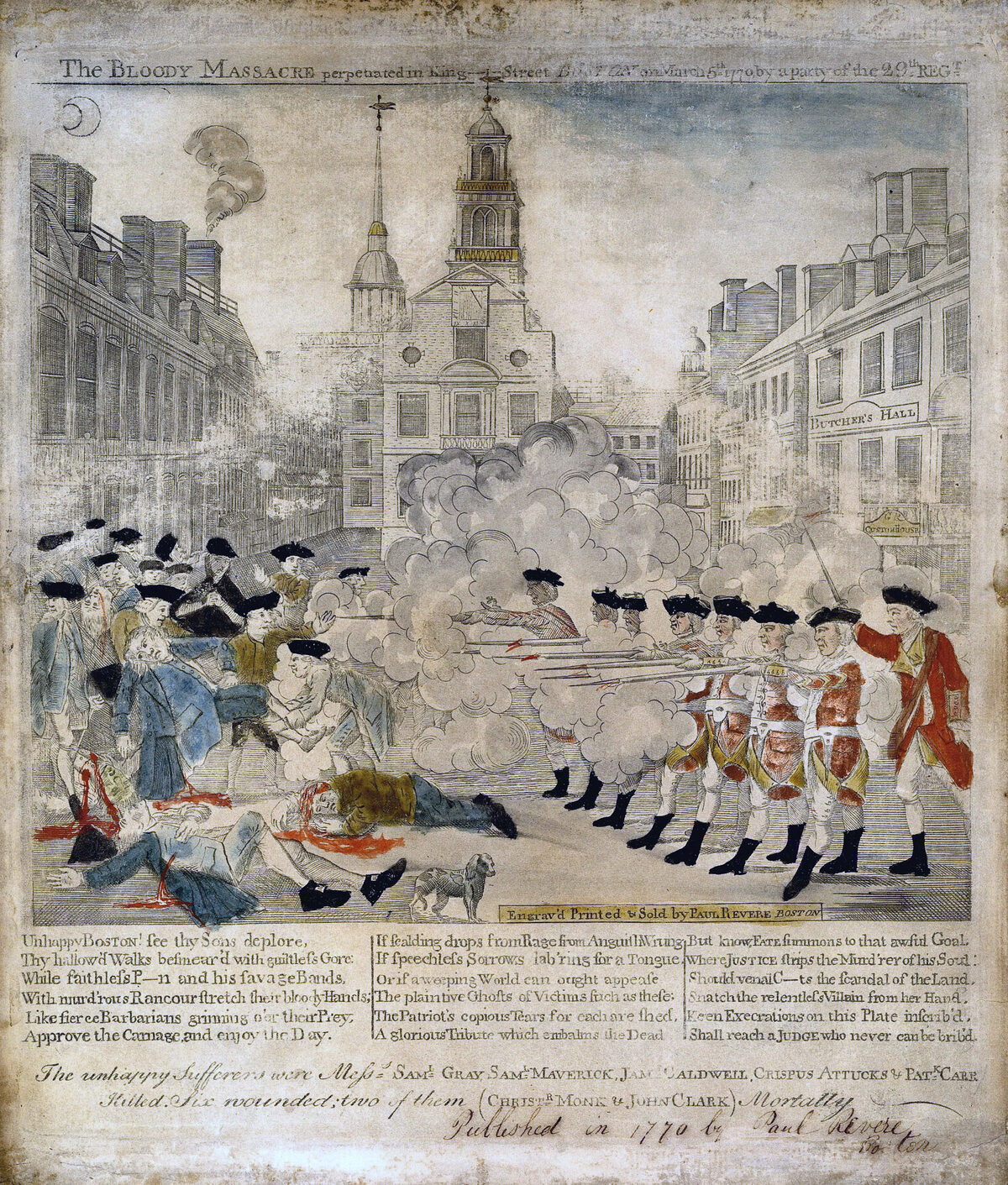
Ideas met friction in the streets of Boston. The Boston Massacre (1770) left five dead and was brilliantly propagandized by Paul Revere’s engraving. The Boston Tea Party (1773) followed. Britain’s furious response was the Coercive, or “Intolerable,” Acts (1774), which closed Boston’s port and gutted Massachusetts self-government. In doing so it accidentally united the colonies into the First Continental Congress. War came at Lexington and Concord in April 1775. Even then it took more than a year of fighting before Congress, in July 1776, finally declared the colonies free. The Declaration recast the whole quarrel as a case against a tyrant king and grounded it in the “consent of the governed.”
Watch:
- John Adams (HBO). IMDb. See the anchors above. This is the movement it dramatizes best.
- The Crossing (A&E, 2000). IMDb. Jeff Daniels plays Washington at the Revolution’s bleakest hour, the December 1776 crossing of the Delaware and the desperate gamble at Trenton. It won a Peabody and is one of the better single-campaign films. Watch: it is not currently streaming and is available on DVD and through libraries only. See where to watch.
- Turn: Washington’s Spies (AMC, 2014–2017), with a caveat. IMDb. Four seasons follow the Culper spy ring, with superb atmosphere for the civil-war texture of the Revolution, where neighbors split into Patriots, Loyalists, and neutrals. It does take real liberties with the history, so enjoy it as drama. Watch: it is on AMC+, and it is free with ads on the Roku Channel in some regions. See where to watch.
- Museum of the American Revolution (YouTube). These are free scholar talks and panels from the museum built for exactly this subject. They include the perspectives of women, enslaved people, and Loyalists that the older films miss. Channel.
The counter-melody: liberty and slavery
A watch list about why America declared independence has to sit with the contradiction at its heart. The Declaration proclaimed all men equal, yet most of its signers, Jefferson among them, enslaved human beings. Jefferson’s draft even included a passage blaming the King for the slave trade, and Congress struck it. The aspiration outlived the compromise, and later generations held the country to it. The honest titles on this list do not flinch from that.
Watch:
- 1776 (1972). The “Molasses to Rum” number is still the most unsparing depiction of the slavery bargain in any mainstream film.
- Thomas Jefferson’s Monticello (YouTube). The foundation’s “Slavery at Monticello” videos confront, directly and without apology, the man who wrote “all men are created equal” while enslaving more than 600 people across his life. They are free. Channel.
- Ken Burns: The American Revolution. This series weaves enslaved and free Black participants through the whole narrative rather than appending them.
A note for families
Liberty’s Kids (PBS, 2002). IMDb. This series runs 40 animated episodes narrated through the eyes of young reporters at Franklin’s print shop. It is surprisingly substantial, touching slavery and divided loyalties, and it is free, with full episodes on the official Liberty’s Kids – WildBrain channel. It is a genuinely good way to bring kids into the story.
How to actually watch this
You don’t need all of it. Three honest paths:
- One evening: 1776, then CrashCourse #6 as a chaser.
- One weekend: all six parts of Liberty!, the complete story, free, in about six hours.
- The deep dive: Ken Burns’ The American Revolution, with Joanne Freeman’s Yale lectures alongside it for the ideas.
Two hundred and fifty years on, the most interesting thing about 1776 is not that it happened. It is that it almost didn’t, and that the people who made it happen knew exactly how much they were leaving unfinished. That is the story worth watching.