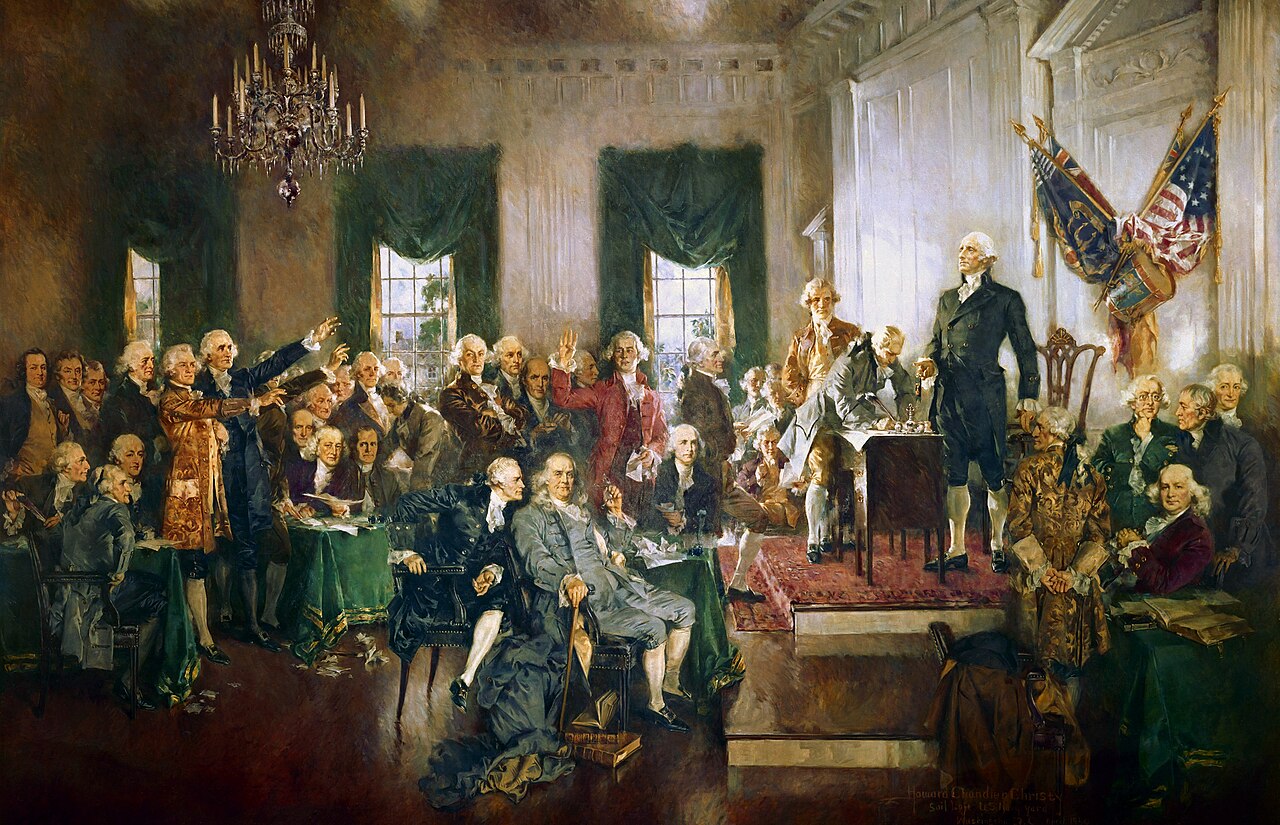
Last month I put together a watch list about why thirteen colonies decided to become a country. This is the sequel, and it asks the harder question. Once they had won independence, why did Americans build their government the way they did? Why three branches instead of one strong executive. Why a Senate and a House. Why so much power stays with the states rather than collecting in Washington. None of that was obvious in 1787, and the people in the room disagreed about all of it.
The short answer is that the design is a machine built out of distrust. The framers had just fought a war against a distant government they considered tyrannical, and their first attempt at self-rule, the Articles of Confederation, had nearly failed in the opposite direction by leaving the national government too weak to function. So they built something in between, and they wired it against the concentration of power on purpose. Authority is split between the states and the federal government, a division we call federalism. Federal power is then split again among three branches that check one another. Understanding that double division is the whole game.
I’ve organized the list around how the system was actually built, in three movements. The first is the failure that forced a redesign. The second is the Convention where the structure was hammered out. The third is the fight to ratify it and the Bill of Rights that was the price of victory. As before, there is a quieter fourth theme running underneath. The compromises that made the union possible also wrote slavery into the founding document, and the honest titles here do not look away from that.
A note on sources. I’ve mixed free and paid, and flagged which is which. Streaming licensing rotates constantly, so treat availability as true only as of mid-2026, and check JustWatch for your region. I’ve also been candid about accuracy and about editorial slant, since this subject attracts more of the latter than the Revolution does.
First, the anchors
If you watch nothing else, watch these. Between them they cover the failure, the Convention, and the structure, and none of them will steer you wrong on the essentials.
- A More Perfect Union: America Becomes a Nation (1989). IMDb. This is the one genuine dramatization of the Constitutional Convention, and it is the film you were half-remembering. Brigham Young University made it for the Constitution’s bicentennial, it runs 112 minutes, and it was filmed at Independence Hall. It centers on James Madison and walks through the collapse of the Articles, the clash between large and small states, and the slave-trade debate. The Commission on the Bicentennial called it a work “of exceptional merit,” and it has been a classroom staple ever since. It is dramatized and it compresses the debates, but it is honest about the substance. Watch: it circulates on DVD through the National Center for Constitutional Studies and has streamed on BYUtv. See where to watch.
- Constitution USA with Peter Sagal (PBS, 2013). IMDb. Four hour-long episodes in which the host of NPR’s Wait Wait… Don’t Tell Me! rides a motorcycle around the country testing how the document actually works. Episode one, confusingly also titled “A More Perfect Union,” is the clearest popular explanation of federalism I know, meaning the sharing of power between the national and state governments. The other three cover rights, equality, and whether the system can keep adapting. Watch: it has been free on PBS, though PBS streaming rotates. See where to watch.
- CrashCourse Government and Politics #4, “Federalism” (YouTube). A brisk, well-sourced ten-minute primer on why power is split between Washington and the states, and what that split means in practice. It is free. Watch. Pair it with #3, “Separation of Powers and Checks and Balances,” which does the same job for the three branches. Watch.
Movement I: The failure that forced a redesign
Americans did not leap from independence to the Constitution. In between came the Articles of Confederation, ratified in 1781, which created a national government so weak it was barely a government at all. Congress could not tax, could not regulate trade between the states, and could not compel anyone to obey it. The states behaved like thirteen quarreling countries. When farmers in western Massachusetts rose up in Shays’ Rebellion over debt and taxes in 1786, the confederation had no reliable means to respond, and that fright convinced men like Washington and Madison that the whole framework had to be replaced rather than patched. The Convention was called into being by failure.
Watch:
- Open Yale, The American Revolution (HIST 116), Prof. Joanne Freeman (YouTube). This is a complete, free Yale undergraduate course. Its final lectures carry the story past the war into the confederation crisis and the turn toward a stronger union, which is exactly the ground this movement covers. It is the deepest free resource on the founding, and it is free. Course.
- CrashCourse Government and Politics #8, “The Articles of Confederation” (YouTube). A short, clear account of why the first system failed and what its failures taught the framers. It is free. Playlist.
- Khan Academy, “The Articles of Confederation” and “Shays’ Rebellion” (YouTube and khanacademy.org). Free lessons that lay out the specific weaknesses, the taxing and commerce problems, that the Constitution was written to fix. Part of Khan’s US government sequence, produced in part with the National Constitution Center. It is free.
Movement II: The Convention and the great compromises
In the summer of 1787, fifty-five delegates met behind closed doors in Philadelphia and, rather than revising the Articles as instructed, wrote an entirely new frame of government. The central problem was representation. Big states wanted seats apportioned by population, small states wanted equality, and the deadlock nearly broke the Convention. The Great Compromise solved it with a two-chamber Congress, a House scaled to population and a Senate of two per state. To keep any one part of the government from dominating, the framers split federal power into a legislature, an executive, and a judiciary, and gave each the means to check the others. This is where the machine was actually assembled.
Watch:
- A More Perfect Union (1989). IMDb. See the anchors above. This is the movement it dramatizes best, and the reason to seek it out.
- Hillsdale College, Constitution 101 (free online course), with a caveat. Twelve lectures covering natural rights, the Convention, the separation of powers, and the structure of the document. It is thorough and clear on the text and the architecture. Be aware that Hillsdale teaches from a firmly originalist and conservative interpretive stance, so treat it as one well-argued reading rather than a neutral one, and balance it with the PBS and Yale material. It is free with a signup. Course.
- National Constitution Center, America’s Town Hall (YouTube). The center’s official channel hosts recorded, deliberately nonpartisan panels in which scholars from left and right argue out how the branches and the federal balance are meant to work. This is the antidote to any single slant. It is free. Channel.
- Khan Academy in partnership with the National Constitution Center (YouTube). Scholar interviews on separation of powers and the branches, built for students and free.
Movement III: Ratification and the Bill of Rights
Signing the document in September 1787 was only the beginning. It still had to be ratified by the states, and that set off the first great national argument about the shape of the government. The Federalists, who wrote the newspaper essays we now call The Federalist Papers, argued the new system was safe precisely because power was so divided. The Anti-Federalists answered that a government this strong, and without a written guarantee of individual rights, would swallow the states and the citizen alike. They lost the ratification fight and won the argument. The Bill of Rights, the first ten amendments, was the concession that brought the holdouts along, and the Tenth Amendment’s reservation of powers to the states is the federalism debate written directly into the text.
Watch:
- C-SPAN and the National Constitution Center, Landmark Cases. A twelve-part series on the Supreme Court decisions, beginning with Marbury v. Madison, that turned the written structure into living practice and established judicial review. It is the best free look at how the branches actually police one another. It is free. Series.
- Annenberg Classroom (annenbergclassroom.org). More than sixty free, nonpartisan videos on constitutional principles and the Bill of Rights, with lesson plans attached. Strong on the rights half of the story that ratification forced into the document. It is free. Site.
- Akhil Reed Amar, Yale online lectures (Coursera). The Yale constitutional scholar’s two courses, “America’s Written Constitution” and “America’s Unwritten Constitution,” are free to audit and are the most rigorous scholarly treatment on this list of how the text was framed and ratified. The certificate is paid, but the lectures are free to watch.
The counter-melody: compromise and slavery
A watch list about why the government is built this way has to sit with what the building cost. The same spirit of compromise that produced the Great Compromise also produced the Three-Fifths Compromise, which counted enslaved people as three-fifths of a person for the purpose of giving their enslavers more representation, and a constitutional shield for the slave trade until 1808. The structure that Americans rightly admire was bought in part with those bargains, and the honest titles here say so.
Watch:
- A More Perfect Union (1989). The film stages the slave-trade debate on the Convention floor rather than skipping past it, which is unusual for a classroom production of its era.
- National Constitution Center, America’s Town Hall (YouTube). Several panels take up the Three-Fifths Compromise and the slavery clauses directly, with historians who neither excuse nor flatten them. It is free.
A note for families
iCivics (icivics.org) and its companion videos. Founded by Justice Sandra Day O’Connor, iCivics teaches how the branches and the federal system work through free games and short videos aimed at students. The game Do I Have a Right? and the branch-focused lessons turn the abstract machinery into something a kid can actually operate. It is free, and it is a genuinely good way to bring young people into the subject.
How to actually watch this
You don’t need all of it. Three honest paths:
- One evening: A More Perfect Union, then CrashCourse #4 on federalism as a chaser.
- One weekend: all four episodes of Constitution USA, the whole working system in about four hours, free.
- The deep dive: Joanne Freeman’s Yale course for the road to the Convention, then Akhil Amar’s Yale lectures for the document itself.
The thing worth remembering is that none of this design was inevitable. The framers did not trust power, including their own, so they split it and split it again and set the pieces to watch each other. Two hundred and fifty years later, the arguments they had in that closed room in Philadelphia are still the arguments we are having. That is not a flaw in the system. It is the system working as intended.